


“Kitzrettung” the german measure to prevent unnecessary deaths of fawns during hay mowing.
Every year countless fawns (the young of a deer) die unnecessary deaths or are injured during the annual mowing of fields. The german measure of “Kitzrettung”, “Save-a-Fawn” offers a solution to this problem of modern haymaking.

Roots of the Problem
Does of the different deer species found in Europe or North America typically put down their fawns in fields with high grass to protect them from predators. The abundant food source these fields offer also promote this behavior. Many such fields are meadows meant for hay production, meaning they are to be cut down with modern mowing machines. The problem is further escalated by the fact that fawns typically try to hide and make themselves smaller if they are in danger, which might help against predators but sadly not against an industrial mower. But how do German farmers and hunters try to prevent these needless deaths?
“Kitzrettung”
In Germany owners and cultivators of land are required by law to prevent unnecessary and avoidable animal pain or deaths. In the context of cultivating hay this means, that appropriate measures must be taken to prevent the death of fawns or other smaller animals during mowing. If those are not taken fines of up to 10.000€ or imprisonment are possible. There are different measures that can be taken to prevent the deaths of fawns. The most easy one would be repellents.
Repellents
There are different kinds of repellents used, ranging from simple smell repellents to ones using lights and sounds. Repellents are typically placed two to three days before the grass is to be mowed. So that for one the does have enough time to grab the fawns out of the field and second that they do not get used to the repellent. If the repellents are, placed too early does will get used to them and place their fawns inside the fields again, and if they are placed too late, does might not have enough time to retrieve their fawns.
Smell repellents are the easiest and cheapest option available. Flower sacks are placed on poles in the field with regular intervals.
Another one similarly easy but more costly are sound and light “machines” they make sounds meant to scar the deer away or flash annoying lights. They can be bought commercially.
Traditional “search and Rescue”
The more traditional and effective method would be “search and Rescue”. The act of walking through the field searching for fawns and moving them out of the fields. Best done as close to the mowing as possible to prevent any additional fawns being laid down or possible returns. A group of people walk in a line through the field and collect the fawns they find. Important here is that gloves are worn, by the people that pick up the fawns. The fawns should only be touched with gloves and if possible together with the grass around them, to prevent possible abandonment by the mother.

The Fawns are then placed inside a box close to that side of the field were the doe most likely would be f.e. a forest. Placing them in a box is important to prevent them from returning into the field.

The measures can be more effective with the additional use of dogs although only well trained ones, to prevent them from attacking a found fawn. Although traditional and easy, “search and Rescue” needs a lot of man power to effectively inspect a field.
Drones
Nowadays the usage of drones in the “Kitzrettung” becomes more common, drones with infra-red cameras are used to search for the fawns in the fields. This search is typically done in the early morning hours around dawn, so the heat cameras can find the fawn as easily as possible.
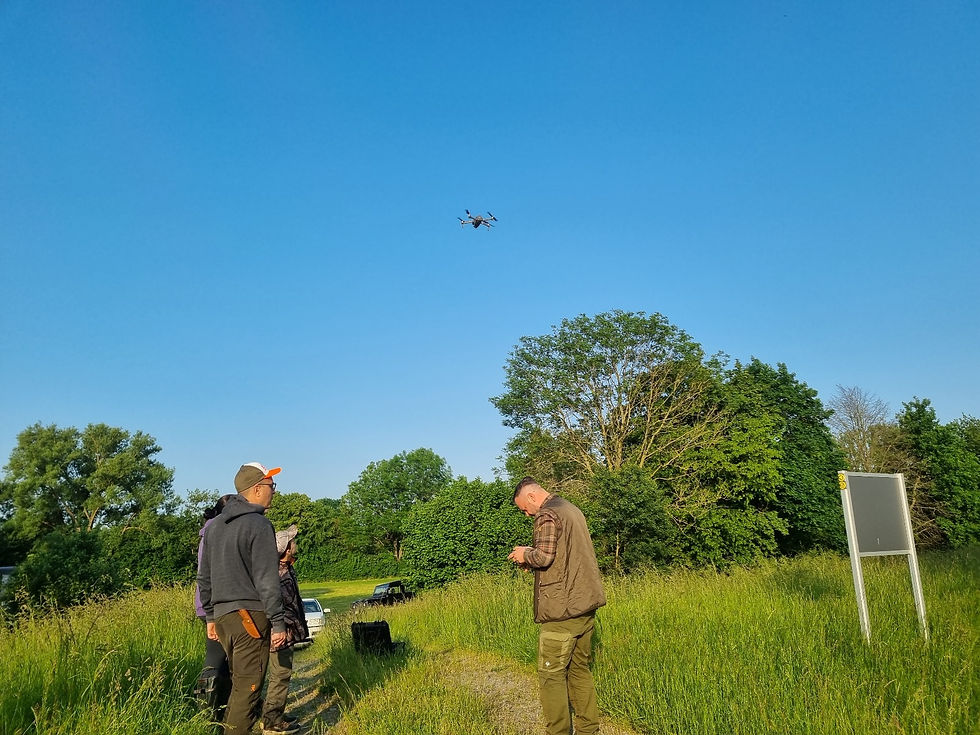
Typically local hunters tend to help farmers with searching since they also benefit from the prevention of deaths, and are responsible for keeping a balanced deer population in their hunting grounds. After the Fawns are found the same meassures as in a normal "search and rescue" are applied.
Fig. 5–8 Additional photos of a Drone search. (By Jens Gebhardt all rights reserved)
Moving forward
This practice of „Save-a-Fawn” is a rare one internationally and one that could be adopted by other countries or other farmers, hunters and animal conservationists. Although the different measures most likely can’t all be adopted at once they help in preventing unnecessary animals deaths or pain. The use of repellents especially is easy to introduce and not that costly, although in the long run drones with heat-cameras will likely be the most effective and also cost-effective measure in “Kitzrettung”.

About the Author: Fabian Kadel student of History/Auxiliary Sciences of History at the Ruprecht Karl University of Heidelberg currently doing an internship at the Experimental Archeology Laboratory Lauresham.


After moving to a new neighborhood, I was looking for a local eye doctor I could trust for regular check-ups and potential new glasses. In the middle of my research, https://optyx.com/ became the resource that stood out. Optyx is a patient-focused eye care center with several New York locations that provides high-quality vision exams, advanced diagnostic testing, prescription eyewear, and ongoing eye health monitoring. Patients frequently highlight the clean, modern offices, knowledgeable doctors, and excellent selection of frames for all ages and budgets. It quickly became my go-to place for all eye care needs.
The Atlas Men's Health article about tadalafil as a pre-workout option highlights how it may improve circulation and oxygen delivery to muscles. This can help with endurance and overall performance during exercise. It also mentions that typical pre-workout doses are lower than standard use, usually around 5–10 mg. That detail makes the article more practical. I like that it emphasizes safety and proper guidance. A solid read overall.
https://atlasmenshealth.com/blog/should-you-take-tadalafil-for-working-out-dosage-and-benefits-explained