


Built for Hay, Built to Last: Hayracks and Slovenia’s Rural Identity
Hayracks, or kozolci, are among the most distinctive and iconic features of the Slovenian rural landscape. These wooden structures, crafted by skilled carpenters, were originally developed to dry and store hay. Over time, they came to embody much more: the ingenuity of Slovenian farmers, their adaptation to changing climatic conditions, regional building traditions, and a deep sense of identity rooted in the land.

Origins and Climatic Context
Before the late Middle Ages, the territory of present-day Slovenia experienced dry and warm summers that allowed hay to dry directly in the fields. However, from the 14th century onwards, climatic conditions began to deteriorate, with summers becoming increasingly wet and unpredictable. This trend reached its peak during the Little Ice Age (16th to early 18th century), when the climate shifted toward cooler, wetter summers with more frequent rainfall. As drying hay in the open became a serious challenge, farmers needed a reliable way to preserve it for feeding their animals during winter. The hayrack emerged as an architectural solution to this climate challenge.

Mowing, Haymaking, and the Role of Hayracks
Traditionally, haymaking began in June, when the grass was fully ripe, and continued through July and into August. At dawn, mowers swung their scythes in a steady rhythm across the dew-covered fields, working until late morning. Around midday, women and children followed, spreading the freshly cut grass with rakes to speed up the drying process. In fair weather, the hay was gathered into small piles (kope) by late afternoon, spread out again the following morning, and finally brought home to the hayloft once it was completely dry.

If the weather was unstable or humid, farmers would load the partially dried hay onto carts and take it to a hayrack. There, they spread it over horizontal wooden beams, sheltered from rain but exposed to circulating air. This allowed the hay to dry properly even in poor weather conditions, preserving its quality. Farmers would use a stool with hooks fastened to the beams for support as they filled the gaps, working either from the top down or from the bottom up.

Structures and Types
The hayrack’s basic structure consists of tall, sturdy posts and horizontal beams, topped with a roof. One of its most distinctive construction features is the interlocking cross-joint (na križ) technique, which ensures the structure's exceptional durability. This strength is not primarily intended for the hay itself but to withstand the strong winds and long, snowy winters common across much of Slovenia, which in the past were even harsher than they are today. Roofs were traditionally made of straw, wood, or slate, while today a wider range of materials is used. The owner's needs and the farm's size and wealth have always determined the size and shape of hayracks and building materials.
Hayracks are still customarily constructed from high-quality timber—though much less frequently than in the past—most often a combination of oak or chestnut with spruce. In earlier times, beech, birch, poplar, pine, and even cherry were also used. In some regions, stone—and later concrete—has been employed for the posts.


Hayracks can be classified into three main types:
· Single Hayrack: the simplest type, featuring a single row of "windows" (openings) with vertical posts and horizontal rails. Variations include two single hayracks set parallel and often connected, as well as the single hayrack with a mantle—a version that has a partially roofed overhang.


· Double Hayrack: a larger and more complex structure with two rows of “windows” covered by a shared roof. Variants include the gable-fronted hayrack (kozolec na psa or na kozla), named for its gable ends resembling a dog’s head (pes) or a goat (kozel); the low hayrack (nizki kozolec); and the double hayrack or toplar, all featuring an enclosed central space used for storage.
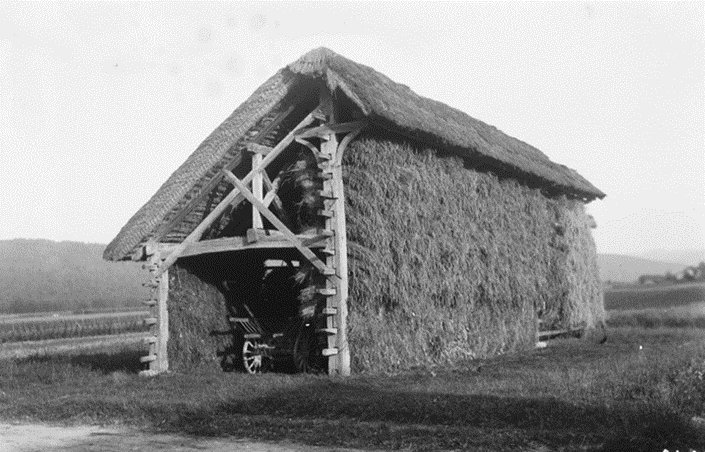


· Lean-to Hayrack: A hayrack built as an extension that leans against another farm building.

Cultural and Regional Significance
Hayracks are rare or entirely absent in the Mediterranean part of Slovenia due to the dry, windy summer climate, which allows hay to dry directly in the fields. Elsewhere in the country, hayrack designs vary by region. In Upper Carniola, simpler forms are more common, while in Lower Carniola and Styria, larger and more elaborate toplars prevail. These structures stand out for their rich ornamentation and skilled craftsmanship—a tradition that reached its peak between the two World Wars. Elaborate construction details and ornamental ventilation openings on their façades transformed them into symbols of prosperity and artisanal excellence. Finely crafted wooden elements elevated hayracks beyond purely functional farm structures, turning them into true rural landmarks.
Hayracks are also found among Slovene minorities in Austria and Italy, demonstrating how this distinctive Slovenian building tradition connects Slovene communities and extends beyond the country’s present-day borders.
As a prominent and everywhere-present feature of the cultural landscape, hayracks reflect the agricultural and livestock-farming traditions that once shaped life in Slovenia. Today, around 1,500 hayracks are officially protected as part of Slovenia’s cultural heritage.


The Land of Hayracks
A unique open-air museum—the Land of Hayracks (Dežela kozolcev)—is located in Šentrupert, south-eastern Slovenia. It is the only museum dedicated entirely to hayracks. The museum displays 19 types of traditional Slovenian hayracks, including toplars and regional variants. It serves as a centre for education, cultural preservation, and tourism; it also highlights the deep connection between hayracks and haymaking traditions.

Hayracks at the Crossroads of Time
Hayracks were used throughout the year—first for drying clover and hay, then for grain sheaves, beans, flax, hemp, and buckwheat, with corn being the last crop to ripen. Even today, some farmers, particularly those on organic farms that value traditional methods, continue to use hayracks for drying hay and other crops.

However, many hayracks are now deteriorating due to the abandonment of farming and lack of maintenance. Single hayracks are disappearing the fastest, while double hayracks are more often preserved, as they can also store tools and machinery and serve as gathering places.

Despite their cultural significance, hayracks receive little formal protection or funding. Urbanisation and modern agriculture have marginalised them. Yet they remain a powerful symbol of Slovenia’s rural past and present. Some are creatively repurposed—as shelters for events, tourist accommodations, or artistic installations—though not always with sensitivity to their heritage value.


To ensure their survival, it is crucial to continue using hayracks for their original function: drying hay. Without this practical use, they risk becoming empty monuments of a fading tradition. Preserving the most significant examples, particularly those with architectural or historical importance, is essential. Hayracks are not only beautiful structures—they are living testaments to the resourcefulness, resilience, and cultural richness of Slovenian rural life.
Barbara Sosič, Slovene Ethnographic Museum, Ljubljana


Really helpful post! One thing I was curious about do you have any advice for Write For Us Gardening? Would love to hear your thoughts.